Monday, February 8, 2016

Bajaj Corp: Target Price- Rs 800/share

Bajaj Corp Limited

Bajaj Corp is involved in manufacturing and selling of FMCG products. Bajaj Corp owns brands like Bajaj Almond Hair Oil, NoMarks, Kailash Parbat and other Bajaj range of hair oils.

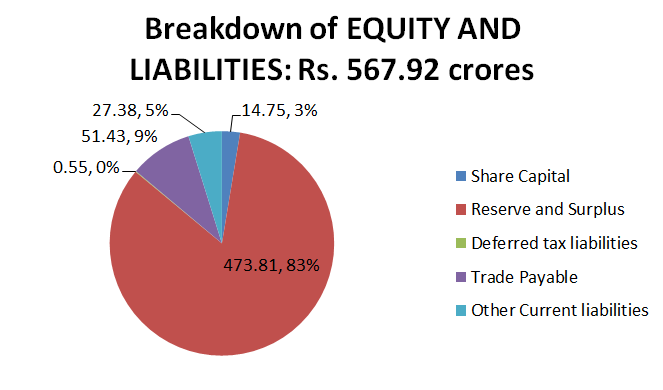
The Company is a debt-free Company. The Composition of Total Liabilities of the Company for the financial year ending March 2015 is shown below.


The composition of Total Assets of the Company for the financial year ending March 2015 is shown below.

Tuesday, November 5, 2013

Dilemna of valuations in stock investing

The year 2013 has been a see-saw for Indian stock markets. The Current Account deficit, the gold demand, the FED tapering, the American debt ceiling all provided the unhindered volatility in prices. 4 months ago, the rupee depreciation caused everybody to write off Indian equity markets with huge sell-off by FIIs. And on this date, Indian stock exchanges are making daily 5-year highs. This is being done primarily on account of huge FII buying while there is little Indian participation, either on retail or institutional front.

There must be a sense amongst the common lot that they have been left out. And they will be eager to ride the bandwagon. And there comes the question of stock selection and valuations. Equity investments is for long term and not for momentum trading. While stock selection is the easiest job when it comes to equity investments, people err when it comes to valuations. In the internet world of today, there are readymade models of valuations available everywhere. But do they suffice, its arguable.

Tuesday, October 29, 2013

Stock Trading Games - boon or bane?

On the day of the last session before Diwali vacations, ICICI Securities came at our Institute of Management, Nirma University to invite us to play Stock Mind, their stock trading game. Even the Placement Committee got so bullish that they took to their ego and made mandatory for everybody to listen to their harangue. The people from ICICI Securities painted rosy picture about stock markets and talked about wealth creation. They took great pain to explain the way inflation ate returns from fixed assets or any other asset class for that matter. I am sure they were able to catch the fancy of most of the lot listening to them.

Most of us would be playing the game by now. And they would definitely be enjoying playing Rs.1,500,000 of virtual money. I am sure some people would have success in terms of making profits while others would be making losses. I hope people having success aren't carried away by their lady luck. And those who are losing might have felt by now that its a pure gambling game. There is no logic involved in it apart from chance, sheer luck. Those having success can boast about having better degree of intuition or God's gift or sixth sense or whatever you name it. There are still days to go into this game and we will all see about that precious gift unfolding.

The point being made here is that one must not be carried by being successful in such trading games. If it would have been a real hard-earned Rs. 1,500,000 in your hands, would one have played such a gamble? Stock markets are about valuations. Those are valuations that go green or red on the marketwatch of your trading terminal. And valuations are reflections of the efficiency of a business. They are not slave to somebody's imagination or intuition. There might be temporary variations. And traders generally try to make hay during this period. But when it corrects, its bad for those uninformed herd-followers. 

We must never forget the 2008 financial apocalypse. It happened because of this particular nonsense intuition where people kept on taking unnecessary risks to the tip of the iceberg. And then, we know about the aftermath, the great floods, the deluge. Economies haven't recovered since then.

Lesson- Intuition is illogical and bereft of any basis. I hope people discover it here in this game, rather than burning their hands out their in actual merciless world.
Monday, August 12, 2013

Effect of elephants on markets

Today while in the marketing class, Prof. P.K. Yadav gave us a situation to work with wherein he took names of four animals and asked us to come out with companies related to the characteristics of animals. One notable name which he took was that of elephant. Elephant is a mammoth mammal which is herbivorous and nobody preys upon it (except when its a calf, some lions might get lucky).This is an animal which feeds upon the natural vegetation merrily without any damn and consequences and isn't part of the food chain later i.e. doesn't become a food for carnivores. It gulps down a huge amount of vegetation and when it gets mad, it causes destruction too. A herd of elephants in an area can be a headache for the local ecology.

It reminded me of companies like Kingfisher Airlines, Suzlon, DLF, Unitech, Educomp Solutions etc. which kept on feeding on the easily available credit of our economic system without any due consideration given to the state of their Balance-Sheets and the damage they were causing to the economic ecology or at least the banking system of our country. Their managements acted like alpha-males taking on unnecessary huge risks and expansions funded by credit as if they were some piece of cake. These companies are still on the horizon mainly because they can't be allowed to falter and that's why there is frequent injection of money supply to let the banking system function to normal pace, but because of which the common man has to suffer the pain or pinch of inflation. And the shareholders have to face the loss of value.

Issues with The Companies Bill, 2012

The main issues still lingering with the Companies Bill, 2012 are:

  1. The concept of independent directors is being brought for the first time in the Companies Bill, 2012. 1/3rd of the board will comprise of independent directors. Do we really think promoters will allow "true independent directors" on board?
  2. Are there enough "true independent directors" available in the market?
  3. Independent directors are allowed 20 directorships at a time of different companies. How can one really contribute in a significant manner protecting shareholders' interests if one serves on 20 different boards simultaneously? Can he or she get that quality time?
  4. 2% on profits has been mandated to be spent upon Corporate Social Responsibilities (CSR). But the term "CSR" hasn't been concretely defined. Nobody knows where the money will be directed towards. Whether it'll go to an NGO surreptitiously involved in black money laundering or towards a genuine NGO involved in underprivileged child education, its highly unpredictable. Also, will it be used for building useless temples on government granted lands for pompous religious purposes or their concern will be genuine social upliftment? Things are still to be clear on that front.
  5. Class action suits have been enabled in the new Companies Bill, 2012. This'll help protect shareholders' interests and prevent Satyam-like fiascos. Now the hard question is whether the shareholders of government owned companies can sue the government. In 2012, Coal India was directed by government to provide coal at lower prices and pained by this, one of the shareholders', The Children Investment Fund, took Coal India to courts. No such light has been shed on this.
  6. There is a provision for at least 1 woman independent director out of 5 independent directors on a board of the company. While the move is directed towards gender equality, there is a huge scarcity for quality women in leadership roles in businesses. Rather than dictating terms on this issue here, the government should focus upon women empowerment and their upliftment. Reservation of any sort in business sphere is going to be counter-productive.
  7. A huge responsibility and liability has been attached to the position of the directors of the company. The Board of the Company now straightaway means a collective body of directors of the company. Director's Identification Number (DIN) has been made mandatory by the Central Government for directorship or else he can't be a director in any company. In times like today, where privacy is getting more and more prized and dificult to maintain, getting on the government watch-list can be a serious dissuader for quality directors, especially independent ones who might not like to be pried upon.

Tuesday, June 18, 2013

Are shareholders part owners of the company?

Shareholders are not part-owners of the company in the eyes of the law. Shareholders can't claim part-ownership in the property of the company. Shareholders simply stay as members of the company. They have been given certain rights by the law such as, to attend meetings, to vote and to receive dividends. This was stated clearly by the Supreme Court in Bacha F. Guzdar vs CIT (supra).

In the eyes of the law, the Company has a separate legal existence as has been envisaged by The Companies Act, 1956. A Company is a juristic person capable of carrying out business activities in its own name. It is a legal entity distinct from its members or shareholders and thus has its own set of rights, duties and liabilities which are separate from the shareholders'. The limited liability of the shareholders or members of the company arises only from this separate legal existence of the company.

Saturday, June 15, 2013

RBI issues fresh directive on Gold imports

Earlier Reserve Bank of India (RBI) had restricted import of gold to consignment basis by banks to meet the genuine needs of jewellery exporters. Now, this provision has been extended to all authorised dealers, nominated agencies or star trading houses taken into account the demands of jewellery exporters. All Letters of Credit (LoCs) are to be issued by such agencies on 100% cash margin basis for all categories of gold imports. Futher, gold will be imported against Documents against Payment basis as against Documents against Aceeptance basis. This requirement willn't be exercised in case of exports of gold jwellery.

Thursday, June 13, 2013

Effect of Gold on Current Account Deficit (CAD) of India

First I'll explain as to what exactly Current Account Deficit or CAD really is. Current Account Deficit happens when your export income isn't able to match your import liabilities. It happens when you earn dollars less than what you spend. Since, international trade happens in dollar denominations, earning dollars is primarily important which also reflects upon the strength of an economy.

Now, the question arises: Why're we earning less dollars? Its because global demand is lull post recession periods of 2009 and our export sector, whether its a manufacturing or services sector, isn't able to gather much business growth. Also, we're facing increased competition from other developing nations in terms of capturing demand at lower prices.

Friday, November 16, 2012

Shortcomings of Financial Statements

Financial statements are prepared by every company to gauge its performance, to report its performance to its shareholders and to comply by regulatory requirements. Though, financial statements provide wealth of information, but it has loads of shortcomings.

  1. Financial statements rely everything on book value. They never give you a reflection of market value. They never tell you about the market value of assets it holds. Suppose, a company buys a fixed asset like land or building, it always gives the numbers in terms of original or historical cost. It never tells you  the present market value of that particular asset. Thus, for every asset, it always gives you the book value. It never gives you the market value.
  2. Financial statement records the cost of the "bought" assets by the company in its statements. But it never records assets created by efforts of the company. For example, a company never records the value of the product or patent created by its Research and Development, though it'll record the value of a bought patent in its financial statements.
  3. Financial statements categorise expenses as operating, financial and capital expenses. Financial statements often err while categorising a particular expense. For example, expenses made on fixed assets are considered as capital expenses by a company and are depreciated or amortised over a period of time. Patents are also assets, but expenses made on its R&D are considered as operating expenses. Similarly, operating leases are also considered as operating expenses which rather should be considered as financial expenses.
  4. Financial statements report the assets on which investment has been already made, but they never tell us about assets on which investment is to be done. This later investment will open new growth avenues for the company. For example, fruits of R&D and patents can be considered as such assets.
  5. Like assets, financial statements don't reflect the market value of liabilities, like debt and shareholders' equity. They simply reflect the book value as usual.
  6. While financial statements are geared towards finding whether a company will be able to meet its obligations of debt and payments to suppliers, they don't throw any light on risk to equity investors.

Wednesday, October 24, 2012

Why stock market defies the natural law of economics?

In Economics, its stated that with higher prices, demand falls and when prices drops, demand increases. Its just the opposite when it comes to stock markets. People buy when prices are sky-rocket high and they stay away from stock markets when its cheap. People often turn a blind eye to stocks when the valuations are at dirt cheap and will rush to grab when the valuations are sheer nonsense. Its very difficult to comprehend this situation when people don't buy a dozen of banana at high prices, then why they happen to buy stocks at costly valuations. When people stop buying and consuming a kg of onion at Rs. 40-50 as part of their food, then how they were able to buy Suzlon Energy at Rs. 500, Educomp Solutions at Rs. 800 or DLF at Rs. 1200 prior to the recession of 2008-09. Currently, Suzlon Energy is trading at Rs. 15, Educomp Solutions at Rs. 158 and DLF at Rs. 205. And when people rush to buy a kg. of onion at Rs. 20-25, they were too sceptical to buy Hawkins Cookers at Rs. 130, TTK Prestige at Rs. 90 or Titan Industries at Rs. 35 during the downturn of 2008-09. Currently, Hawkins Cookers is trading at Rs. 1800, TTK Prestige at Rs. 3100 and Titan Industries at Rs. 275. This is where investors defy the basic law of Economics that with higher prices, demand falls and when prices drops, demand increases. People are all vice versa to that in respect to their stock investments. This is a question worth pondering over. I'm not able to find the answers. Perhaps people can. Kindly comment.

Dynamics of Profit and Loss Statement

The Profit and Loss Statement of a business or a company tells a lot about the business. Analysing the statement historically can give one important insights into the functioning of the business. The Profit and Loss statement tells us about what the business has done and what it has earned over a period of time. It tells us about the working dynamics of the business.

The Profit and Loss statement consists of following parts, in general:
  1. Operating Revenue
  2. Cost of Raw Materials
  3. Purchase of Traded Goods
  4. Salaries and Wages
  5. Sales, Promotion and Marketing Expenditure
  6. Other Expenditure
  7. Depreciation
  8. Financial Expenditure
  9. Other Income
  10. Taxation
  11. Profit after Tax

Saturday, October 20, 2012

Operating Margins

Every business has its characteristic Operating Margins. Operating Margins don't expand and retract radically with passing time. Its the level below which the business doesn't wish to sell. Operating margins are calculated after taking into account fixed operating costs. It simply can't be calculated straightaway. The level is reached after a number of internal assessments. In case of brands, supposed brand value is also incorporated into the margins. A healthy Operating Margin is essential for the growth of the business.

Operating Margin can't just be increased at will as it'll result in increment of prices taking into account that fixed operating costs is constant. Increased prices of products can result in your competition eating into your market share or customers turning away from you or cutting their discretionary spending. Increased Operating Margins from increase in prices shall be viewed with caution. Operating Margins can also improve from certain structural changes in fixed operating costs. Reduction in any kind of fixed operating costs can lead to improvement of Operating Margins which must be welcome.

Friday, October 19, 2012

Reliance Industries Limited - Steady and Still

Reliance Industries Limited (RIL) is one of the largest companies of India by market capitalization. The business has interests in petrochemicals, oil and gas exploration, textiles, retail. Reliance Industries has been a very dominant force in Indian industry circles. In March 2012, RIL did a sales of Rs. 3,58,501 crores, a growth of 34% over last year. RIL has Operating Margins of 11%. RoCE for RIL is 16.50%.

Despite such huge size and in engineering sector, RIL has excellent Operating Cash Flows. RIL gets its money from its customers within 17 days. RIL consumes its Inventories within 52 days. RIL pays its suppliers after 46 days. Overall, RIL is able to converts its money within 22 days, which most of the engineering goods companies in India will be jealous of. Debt/Equity for this company is at 0.48. This is possible because of the quick cash conversion by RIL as it provides liquidity at their hands.

RIL is sustaining and still growing stronger, despite its huge size, because of the quick cash conversion cycle. Its because of the positive Operating Cash Flows. Any company, big or small,  will suffer down the line if they fumble with their Operating Cash Flows. Thus, investors must pay dear attention to Operating Cash Flows.

Dish TV - sab par "Loss" sawaar hai - Dish karo yaa Ditch karo?

Dish TV was the first company in India to roll out DTH services in India. It roped in Shahrukh Khan as its brand ambassador. Ever since Dish TV initiated itself, it is beset with problems. For a long time, Dish TV suffered operating losses. In the mean time, they underwent equity dilution couple of times.

In financial year March 2012, revenue from operations was Rs. 1957 crores, an increase of over 36% on Rs. 1436 crores of revenues registered last year. Operating Profits greatly improved at Rs. 566.7 crores at a margin of 29% as compared to Rs. 360.66 crores at a margin of 25%. The Net Loss suffered by the company is mainly because of Depreciation and Interest costs. Loans have greatly increased to Rs. 1214 crores from Rs. 648 crores over last year, an increase of 87% which can be a bit of concern. RoCE is coming out to be 50% for this year, which is quiet impressive in terms of business returns. This is mainly because Dish TV operates on negative working capital. The company has good positive operating cash flows despite Net Loss, mainly on account of huge Depreciations in the Profit and Loss statements.

Wednesday, October 17, 2012

Which business will grow faster?

I'll give you case of two businesses. I'll first explain the situation around these businesses. 

Business 1: The revenue is growing at 25% annually. Similar is the growth of Profit After Tax. At present, the company has no debt. Return on Capital Employed (RoCE) is at 30%. Operating Cash Flows are 25% of the Operating Profits.

Business 2: The revenue is growing at 25% annually. Similar is the growth of Profit After Tax. At present, the company has no debt. Return on Capital Employed (RoCE) is at 30%. Operating Cash Flows are 120% of the Operating Profits. 

The difference between the above two instances is Operating Cash Flows. What is going to be the impact of Operating Cash Flows?

Monday, October 15, 2012

What Rakesh Jhunjhunwala saw in DB Realty?

Rakesh Jhunjhunwala recently made an investment into DB Realty. This is the same company whose Chairman, Shahid Balwa, was made a party to 2G accusations list a few months ago. The Chairman and the company was shown to have provided Mr. Sharad Pawar, Agriculture Minister with certain favours.

In financial year ending March 2012, DB Realty did an annual sales of Rs. 590.86 crores, almost half of what it did in the previous year. Operating Profit is at Rs. 124 crores at a margin of around 20%. Debt/Equity ratio is at 0.06. Total Assets of the company is at  Rs. 5191.08 crores. Working Capital of the company is Rs. 1363 crores. Fixed Assets is Rs. 245 crores. RoCE is 7.11%. Share price is Rs. 98.75.

What we can see from here id that DB Realty is very under-leveraged as compared to other real-estate companies. Debt is at a very comfortable situation. If we talk about Total Assets, Total Assets per share of the company is coming out to be Rs. 213.44 crores. If we talk about Capital Employed, Capital Employed per Share is at Rs. 66.11. In June quarter this year, the company did Sales of only Rs. 85 crores made a net loss. If we see just at Project Expenses only as a percentage of Sales, its ranging between 60-90% over several quarters.

So, what could have made Rakesh Jhunjhunwala commit an investment into this company. First, Total Assets per share of the company is way beyond the current Share price. Second, certain projects of the company have been recently completed and others are due completion in near months. Will one invest into it based upon these parameters? Will this company provide a steady stream of revenues, profits and operating cash flows?

Saturday, October 13, 2012

The fizzling Suzlon Energy

In the financial year March 2005, Suzlon Energy did an Annual Sales of Rs. 1942.48 crores. They did an Operating Profit of Rs. 473.40 crores, the Operating Margins being 24.37%. Capital employed was Rs. 1300 crores. RoCE came out to be around 35%. Debt/Equity ratio was about 0.50.

In the financial year March 2012, Suzlon Energy did an Annual Sales of Rs. 21,082.37 crores. They grew their Sales by 10 times from 2005. Operating Profit came out to be Rs. 1544.36 crores with the margin percentage being 7.33%. Capital Employed is around Rs. 15,500 crores. RoCE is at around 10%. Debt/Equity ratio is 2.

The maximum Sales was recorded in the year 2009 at Rs. 26,081 crore. Maximum debt was also acquired in the same financial year of 2009 as debt jumped 4 times from Rs. 390 crores in financial year 2005 to Rs. 14,700 crores. Most of the debt was meant for fixed assets for fixed assets walloped 3 times to Rs. 13,281 crores from Rs. 4568 crores. Capital Employed for that year is Rs. 24,500 crores. Operating Profit for the same year is Rs. 2849.71 crores at margin of 11%. RoCE came out to be around 10%.

Mismatch between Operating Cash Flows and Return on Capital Employed (RoCE)

Return on Capital Employed (RoCE) is the return on Fixed Assets as well as Working Capital. It indicates towards the efficient use of the two forms of capital. RoCE indicates towards the efficiency of the business. It indicates towards effective capital allocation. A company/business with higher RoCE is deemed good.

Operating Cash flows is the actual amount of money emerging from the business. It takes into stock money stuck in inventories, with customers and money given as advances or paid as loans. Thus, operating Cash Flow is pure cash coming out of the business within a period of time. Net Profits or Operating Profits is just profits or money on paper, while Operating Cash Flows is the crude cash coming out of the business. Operating Cash Flows as a proportion of Net Profits or Operating Profits is an effective indicator of the Cash Conversion Cycle of the business.

Thus, even though a business or company might have a higher RoCE, it doesn't necessarily mean that they're generating actual Cash. If a business isn't able to churn out actual cash, then it will have to take Working Capital Loans to maintain the running of business, thus incurring interest expenses and lowering of Net Profits. So, a lone look at RoCE doesn't actually work.

Friday, October 12, 2012

Working Capital and Return on Capital Employed (RoCE)

Working Capital or Net Current Assets is the difference between Current Assets and Current Liabilities. This is the money with which the business is run. Working Capital makes Sales happen. Working Capital is arranged in the form of Inventories, Sundry Debtors or Account Receivables and Sundry Creditors or Account Payables. The distribution of the capital between the three items becomes the face of any business. This distribution is characteristic of a particular business and  a business is seldom able to change this structure over its lifetime. This distribution of capital is indicative to investors to be worthy of investment. Everybody will like to be invested in business which lower distribution of capital in Inventories and Sundry Debtors. This indicates that inventory is readily consumed and sale money is not stuck with customers.

As I said earlier, Working Capital makes Sales happen. Working Capital is the money with which we buy Inventories, process it, then sell it, receive the cash from customers and pay the suppliers of the inventories. The ratio of Sales and Working Capital indicates the efficient use of Working Capital. Its an important indicator which an investor must pay attention to.

Return on Capital Employed (RoCE) is simply Operating Profits over Capital Employed. Capital Employed is the addition of Fixed Assets and Working Capital. RoCE is an effective indication of the returns being generated from the business. It indicates the effective use of Fixed Assets and Working Capital.

Thus, a better RoCE is mainly reliant upon the effective use of Working Capital. The arrangement of the capital across the components of Working Capital and RoCE indicates towards the quality of the business.

Thursday, October 11, 2012

The sad story of Educomp Solutions

People hear about rags to riches story a lot. We're going to talk about Educomp Solutions. Educomp Solutions was the first mover in the digital educational content provider space. In short span of time, it grew tremedously providing a booster to shareholders' value. Something around the end of 2008 started going wrong for the company. Satyam fiasco happened at that time. Satyam was accused of inflating its revenues and its Chairman  Ramlinga Raju accepted the fraud committed by him. Around that time, CBI also started looking into Educomp. Though, nothing emerged concretely but it was rumoured that Educomp Solutions was cooking its books similarly to Satyam. It was inflating its revenues to drive the share prices. Educomp must had some political connections to get the CBI off its back. Then, after some time, SEBI summoned the Chairman Shantanu Prakash for some insider trading antics. SEBI and Shantanu Prakash reached a non-disclosure agreement by paying SEBI a certain amount of fine. It was rumoured that the Chairman and other high-end employees of the company were involved in insider trading. In 2009-2010, they raised Rs. 607 crores through private placements and diluted shareholders' equity. In 2011, an Income-Tax raid happened on Educomp Solution premises. Meanwhile, Chairman Shantanu Prakash started having bitter relations with his then CFO, Sangeeta Gulati, who resigned from Educomp Solutions very recently. It was rumoured in Educomp Solutions workplace that Sangeeta Gulati wielded more influence on Educomp Solutions than the Chairman himself. In the beginning of 2012, the company was able to raise money to pay off the burdensome FCCBs overseas. In 2011, they were able to securitise certain of their fixed assets with the help of the banks to improve their operating cash flows. But nothing much happened to that extent, as the company was laden with debts and with operating cash flows still struggling. Meanwhile, other big players entered this sector and have now almost commoditised this sector with the revenue per unit falling down.

From 2008 to 2012, Educomp Soplutions has trebled its debt. From 2010 onwards, profits have suffered a lot for this company. They have almost halved. For 2012, profits are already down. EPS has halfed from 2011 onwards. Despite securitisation programme, fixed assets are continuously growing up. Net Cash Flows have turned negative from 2010 onwards. Recently, the company announced that it needed to borrow money again. And, revenue per unit is falling down in wake of new entrants entering this sector. Stock prices are ever falling down. From highs of Rs. 600 in 2010 to dismal lows of Rs. 128 in 2012, this company is witnessing a gradual decline. In late 2011, Chairman Shantanu Prakash was talking about selling some of the fixed assets like schools to compensate for required money.

We can just hope that this company doesn't become a riches-to-rags story.